Dated all year and still single at the holidays?
Forty first dates, two almost-relationships, one very long spreadsheet of a year. Showing up alone to the family table can feel like a public result. It isn't one, and the frustration usually says more about the season than about your odds.
Jump to a section
You haven’t failed, even if it feels like you’re turning in a report card at Thanksgiving. A year of dating in your 30s that didn’t end in a relationship is frustrating, and it’s also normal and usually full of progress you can’t see from the dinner table. The holidays make the outcome look like the whole story. It’s one chapter, and it isn’t finished.
Why does it feel like a public result?
Teodora is 35, a pharmacist, and she’s done the work this year. Two apps, a run club, a friend’s setup, around forty first dates by her own count. There was the architect who seemed promising for six weeks and then went vague. There was the guy she liked a lot but who wanted to move to Denver. She ended one thing she knew wasn’t right, which was harder than staying.
Then she gets to her parents’ house and her mom asks, gently, “Anyone special this year?” and all of that effort collapses into one word: no.
Split it up:
- What happened: her mom asked a question she’s asked every year.
- The reading: “A year of trying, and I have nothing to show for it.”
- The fear: that the trying doesn’t work for her.
- The next step: answer the question she can answer (what she learned), not the one she can’t (when).
The pressure isn’t just in her head. In a 2023 national poll, 41% of adults said their stress goes up during the holidays, and 43% said holiday stress gets in the way of enjoying them.1 Add being the single one at the table to that baseline and the season is doing a lot of the damage.
Is next year going to feel this bad?
Probably not, and that’s not a pep talk. It’s one of the more reliable findings in psychology. People overestimate how intensely and how long a future event will make them feel, especially bad events, and underestimate how fast they’ll recover.2 Researchers call it the impact bias.
At the table, the impact bias sounds like “If I’m still doing this next Christmas, I’ll be devastated.” Your actual future self will have a whole year of other things going on: work, friends, a trip, possibly someone. The forecast is made from inside one bad moment. Discount it.
Why does December make you want to just pick someone?
Because fear of being single can quietly lower your standards. In one set of studies, people who feared being single more were more likely to stay in relationships that weren’t satisfying them, showed more interest in dates who weren’t very responsive, and were less selective at speed dating.3
That’s worth knowing in December, when the person you’d normally pass on starts to look like a reasonable answer to “anyone special?” You’ve worked too hard on your standards this year to trade them for one easier dinner. Let the next decision about someone wait until after the 26th.
Can you want a good holiday without wrecking it?
You can, if you hold the want loosely. In two studies, women who placed a high value on feeling happy felt less happy in good situations, because they were disappointed in their own feelings.4 The more you need the holidays to feel warm and complete, the more each ordinary moment feels like it’s falling short.
So aim lower, on purpose. “I’ll have one good conversation with my brother” is a goal you can hit. “I’ll feel fine about being single all week” is not, and you don’t need it.
Love versus logistics: what to do with the week
Not every part of dating is about love. A lot of it is logistics: time, energy, the calendar. December is bad logistics. Calendars are full, people travel, and nobody’s at their best. Treat it that way:
Pause the apps on purpose. Not because you’re giving up, but because dating in a month nobody is free is like job hunting the week of Christmas. Tell yourself the date you’ll restart.
Keep one door open, lightly. If there’s someone you’ve seen twice and liked, send one specific plan for after the holidays (see the scripts). That’s not desperation. It’s a calendar entry.
Bring the real answer. Researchers who study single people point out that the belief that couples are happier and more fulfilled is a cultural script, and actual differences are smaller than people assume.5 You’re allowed to say, out loud, that your year was good.
Plan your own good night. One evening in the week that’s entirely yours, with the people or the quiet you actually want.
What doesn’t the research show?
- The holiday stress figures come from one national poll of all adults, not single daters specifically.
- The fear-of-being-single studies show patterns across several samples, not what any one person will do.
- None of this tells you when you’ll meet someone. It only tells you that December is a bad month to judge the question.
Try it
Tick what this year of dating actually looked like
Steal this text
Say it in your own words, or start from these
When your dad asks how the dating's going
Lots of first dates, a couple of good ones, nobody I'd bring here yet. I'm pickier than I used to be, which is a good thing.
When your sibling teases you
I went on more dates this year than you did in your whole twenties. I'm fine. Pass the potatoes.
To the person you've seen twice who asks about holiday plans
I'm with family till the 26th. I'd love to get a drink when I'm back, does the 28th work?
Know someone who's tired of dating and dreading the questions?
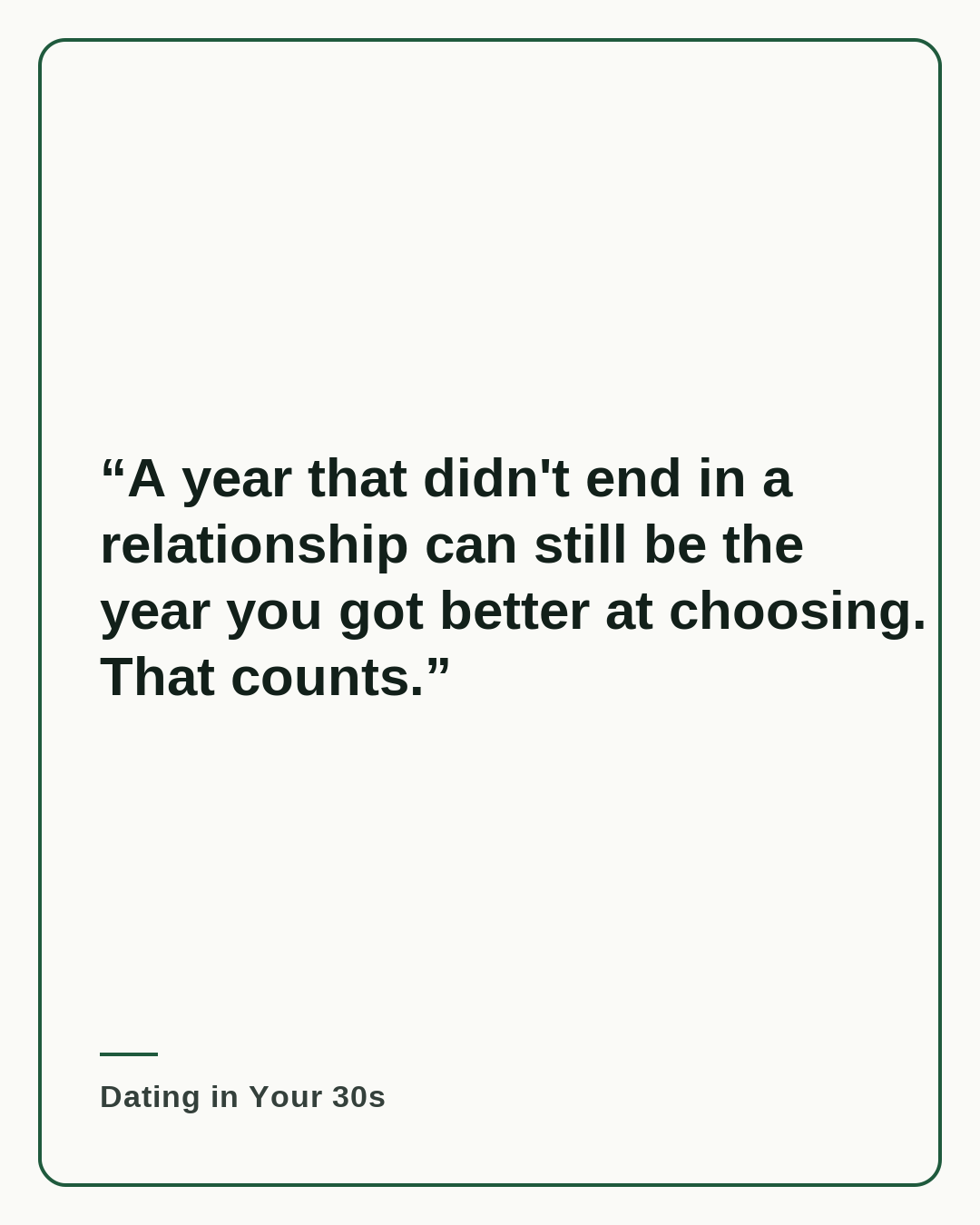
Send them this card with a line of your own. Sometimes a reminder from a friend lands better than any advice.
Nothing you type here is saved or sent anywhere unless you send it yourself.
People who talk about this
- Credentialed source
Alexandra H. Solomon
Relational self awareness, dating and building lasting relationships, drawn from her couples work and her Northwestern course.
- Credentialed source
Eli J. Finkel
Research on how modern marriage and long term relationships work, and what partners expect from each other.
- Credentialed source
- Trending voice
Julie Menanno
How couples get stuck in conflict cycles and how to feel secure with a partner.
- Credentialed source
Justin J. Lehmiller
Research on sex, desire, casual relationships and friends with benefits.
Further reading
Pew Research Center, 2024
Marriage and dating in the US: Key facts for Valentine's Day (opens pewresearch.org)Current numbers on partnering, marriage and dating that put your own timeline in context.