Date ideas for couples in their 30s that research backs
By your 30s, date night can shrink to the same table at the same restaurant, or a show on the couch. Relationship researchers have tested what happens when couples swap pleasant routines for something new to both of them. The results point to a simple rule for picking dates, and it doesn't require skydiving.
Jump to a section
The best date ideas for a couple in their 30s are things neither of you has done before. In randomized trials, couples who spent time each week on activities that felt new and exciting reported higher relationship satisfaction than couples who stuck to pleasant, familiar ones.12 And it doesn’t have to be an adrenaline rush. What mattered was learning or trying something new together.3
What makes a date idea work in a long relationship?
Novelty you share. In a 1993 experiment, 53 married couples were assigned to spend 1.5 hours a week for 10 weeks either on activities they found exciting or on ones they found pleasant. The exciting group ended up more satisfied than the pleasant group. Simply doing more things together, without the novelty, didn’t beat the control group.2
A newer trial got similar results online. 101 couples were randomly assigned to a four-week program with ideas for exciting activities, about 90 minutes a week, or to a waiting list. The activity couples reported more excitement, more positive mood and higher satisfaction, and they were still above where they started four months later.1
Does it have to be thrilling?
No. Many earlier studies tested activities that were both new and physically arousing, such as a 7-minute lab task.53 A 2018 set of studies pulled those apart and found that the sense of growth and novelty, not the arousal, predicted the benefits.3
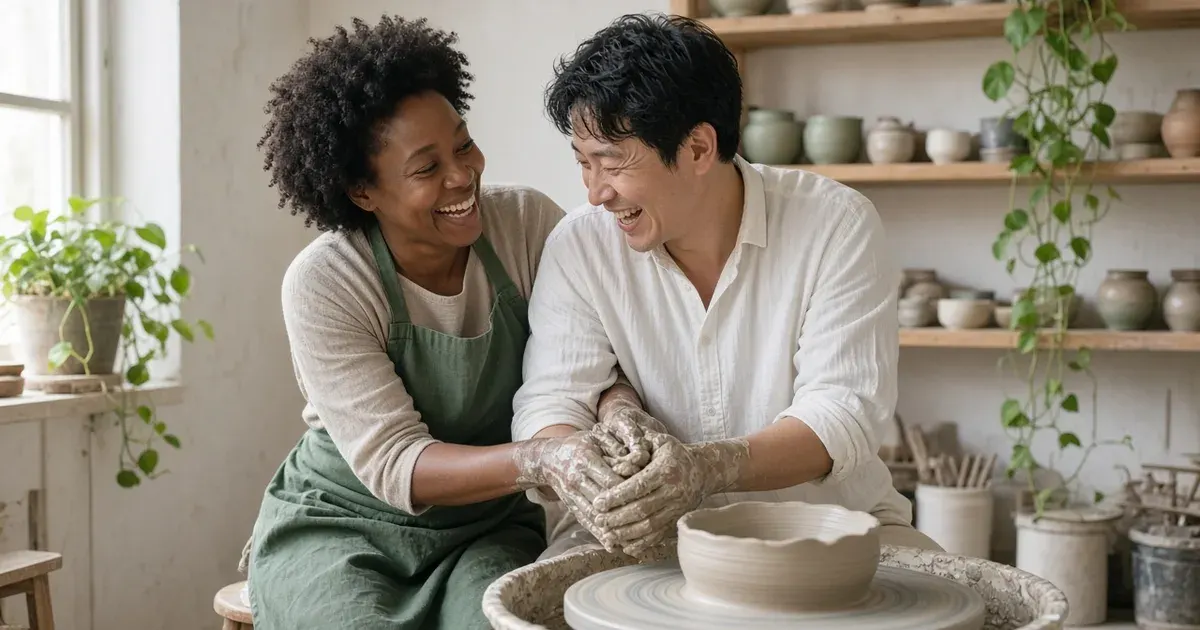
So a pottery class counts. So does a museum late night, as long as it’s new to both of you.
Date ideas for couples in their 30s
Each of these follows the same rule from the studies: new to both of you, done together.23
| If your usual date is… | Try instead |
|---|---|
| Dinner at your regular place | Dinner in a neighborhood neither of you knows, chosen on the walk there |
| A movie at home | A beginner class you both take together: ceramics, salsa, climbing, a language |
| Brunch | An early-morning hike or bike route you’ve never done |
| Drinks with the same friends | A volunteer shift or a community event you’ve never been to |
| Cooking your go-to meal | A cuisine neither of you has cooked, from scratch |
| Scrolling side by side | A game, puzzle or trivia night where you’re a team |
Does novelty affect desire too?
It seems to. Across three studies, including daily diaries and an experiment, doing self-expanding activities with a partner was linked to higher sexual desire. That desire went with greater relationship satisfaction and more satisfying sex, and the benefit held over time.4
Key takeaways
- Exciting beat pleasant in a 10-week trial with married couples.2
- About 90 minutes a week was the dose in a four-week trial with lasting gains.1
- Novelty, not adrenaline, drove the benefits.3
- New activities together went with higher desire.4
If date night keeps turning into a debrief of everything that’s bugging you, when everything your partner does annoys you is worth a read. For a calmer way to take stock together, these relationship check-in questions give you a starting list.
Try it
What does date night look like for you two right now?
People who talk about this
- Credentialed source
Alexandra H. Solomon
Relational self awareness, dating and building lasting relationships, drawn from her couples work and her Northwestern course.
- Credentialed source
Eli J. Finkel
Research on how modern marriage and long term relationships work, and what partners expect from each other.
- Credentialed source
- Trending voice
Julie Menanno
How couples get stuck in conflict cycles and how to feel secure with a partner.
- Credentialed source
Justin J. Lehmiller
Research on sex, desire, casual relationships and friends with benefits.
Further reading
Pew Research Center, 2024
Marriage and dating in the US: Key facts for Valentine's Day (opens pewresearch.org)Current numbers on partnering, marriage and dating that put your own timeline in context.
Sources
- Effects of an intervention designed to enhance romantic relationship excitement: A randomized-control trial
- Shared Activities and Marital Satisfaction: Causal Direction and Self-Expansion versus Boredom
- Do shared self-expanding activities have to be physically arousing?
- Broadening your horizons: Self-expanding activities promote desire and satisfaction in established romantic relationships
- Couples' shared participation in novel and arousing activities and experienced relationship quality